Privacy and Evolution of SNARKs
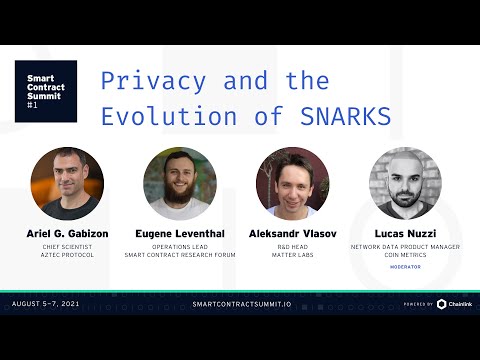
summary
Discussion claims PLONK universal setup removes per-circuit trusted ceremonies and shaves constants so recursion becomes practical; RedShift polynomial commitments adapt FRI-style proximity tests to avoid trusted SRS and enable KZG-like schemes without heavy preprocessing. Implementations report recursion cost differences (verification keys can be ≈5x larger when non-uniform), zkSync v2 targets user-defined Solidity-compiled contracts and is in final testing, and trade-offs center on proof size vs prove time vs verifier cost and on curve risk (BN254 vs BLS12-381 vs discrete-log/Halo alternatives).
AI-written summary · about
chapters (13)
- 0:00Intro
- 0:43Welcome
- 2:04How did you get into SNARKs
- 3:45Alexs SNARK background
- 6:09ZK Rollups
- 7:58Recursion
- 10:49Application
- 12:30Universality
- 13:43Redshift
- 15:29History of Redshift
- 20:36Nonpreprocessing SNARKs
- 27:51Tradeoffs
- 30:45Security
related talks
 23mSonic: Nearly Trustless SNARK Setups
 36mPanel Discussion
 18mA Selection of Pairing Based zk-SNARKs
 18mSoK: Understanding zk-SNARKs: The Gap Between Research and Practice
 56mCollaborative zk-SNARKs: Proving as One over Distributed Secrets
 52mFaster, Smaller, Weaker, Darker
 48mzkSNARKs — Cryptographic Proofs for Scaling and Security Challenges
 31mSecure Distributed Storage