Jon Peck - SeattleJS Conference 2017

summary
Demos run entirely from the browser calling public APIs: image and video colorization (video processing moves to a serverless functions endpoint to avoid frame-transfer latency), saliency-based object tracking, and car make/model recognition hooked into TimelineJS. Uses API connectors like IFTTT/Automate.io for orchestration and the Algorithmia marketplace with 3,500 algorithms. Typical demo code is minimal — demos under three hours — and many APIs return in under 50 microseconds, letting apps reuse trained ML models without building datasets or GPU infrastructure.
AI-written summary · about
chapters (13)
- 0:00Introduction and speaker intro
- 1:05APIs versus local libraries
- 3:31API characteristics and trade-offs
- 7:02When to use remote APIs
- 9:09Machine learning APIs
- 11:58Live demos from the browser
- 14:25Finding and using APIs
- 15:50API connectors and automation
- 16:34Building your own APIs
- 19:26Serverless API hosting
- 21:10General-purpose APIs and community
- 22:35Algorithmia and API marketplaces
- 24:21Closing and resources
related talks
 46mArtificial Intelligence with JavaScript
 11mAI-powered JavaScript applications
 34mAI and JavaScript, no You're Not Dreaming
 19mML at Client Side
 24mThe next level apps for Web developers Machine learning on browsers 🤯
 29mWait, you can do that with JavaScript…!?
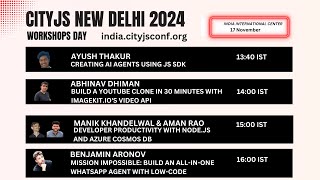 03h 41mCITYJS NEW DELHI DAY 2
 20mKeynote: Building Great Web Experiences with AMP and TensorFlow.js