Performant and Portable High-Performance Computing at Scale via Python and Numba
summary
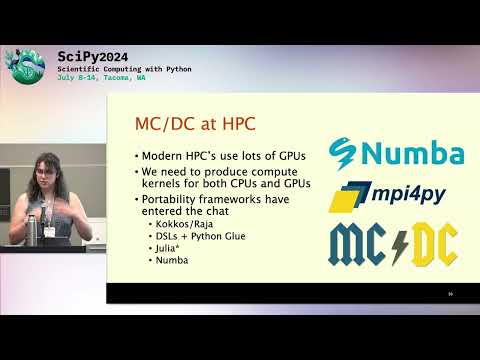
MC/DC is a Python Monte Carlo radiation-transport code compiled with Numba to target CPUs and GPUs; it runs JIT compile steps of about a minute and a half, uses MPI for process parallelism, and stores particle state in a single NumPy ND array. Performance is typically 2–10× slower than C/C++ production codes, but a recent refactor raises figure‑of‑merit from 2.24 to 7.32 and cuts runtime ~75%, and a GPU run shows 21–24× speedup on a node vs two Xeon CPUs while handling up to ~1e9 particles. Limitations: MPI-in-nopython, long compile times, sparse GPU NumPy support, and hard-to-debug compiler errors.
AI-written summary · about
chapters (19)
- 0:00Introduction and speaker background
- 1:10Project mission and consortium details
- 2:14Nuclear chain reaction simulation context
- 3:58Monte Carlo neutron transport basics
- 6:05MC transport solver and MC/DC code
- 8:57Key takeaways from the approach
- 10:43Performance portability frameworks
- 12:50Numba as the chosen framework
- 13:52MC/DC code structure and workflow
- 15:35Numba compilation and kernel design
- 16:39Performance results and comparisons
- 18:45Rapid methods development benefits
- 19:30GPU support and challenges
- 20:52GPU performance metrics
- 21:32Limitations of Numba
- 22:56Alternative frameworks and Julia
- 23:39AMD GPU support progress
- 24:01Conclusion and future directions
- 24:47Q&A session