wolfBoot: Open Source Secure Boot and Remote Firmware Updates in Safety-critical..

summary
An open source secure bootloader implements RFC 9019-style SUIT manifests, uses wolfCrypt (FIPS 140-2 and DO-178C DAL‑A certified crypto) and ships host tools for key generation, signing and encrypted or delta updates. It runs in ~10 KB footprint, ports to Cortex‑M/A, RISC‑V, PowerPC and x86 (even Intel TigerLake replacing SlimBoot), enforces no interrupts, no dynamic allocation and predictable execution flows, performs a power‑fail‑safe swap with two-image rollback, includes glitch/side‑channel mitigations tested on Cortex‑M, and supports bootloader self‑update.
AI-written summary · about
chapters (11)
- 0:00Company overview
- 2:09Product ecosystem
- 5:20Secure boot principles
- 9:47Introduction to wolfBoot
- 15:20Architecture and portability
- 17:24Key management and trust
- 20:54Boot and update strategies
- 24:53Standard operating flow
- 26:22Fail-safe mechanisms
- 31:28Conclusion
- 33:25Q&A session
related talks
 35mMake Your System Firmware Faster, More Flexible and Reliable with LinuxBoot
 01h 03mTrusted Firmware M : Trusted Boot
 42mImplementing UEFI-based Secure Boot + OTA Update for Embedded ARM De...
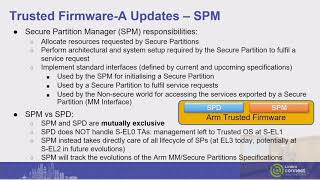 27mSecuring Arm Servers
 39mSecuring firmware: Secure and Trusted boot in OpenBMC
 24mIntroduction to MCUboot: Secure Bootloader and Easy Firmware Updates
 06mSecure IoT updates bootloader on NXP FRDM-K64F ARM Cortex-M4
 45mUsing Secure Boot for the powers of good