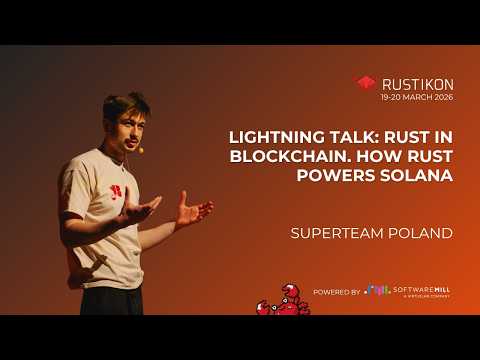
Lightning talk: Rust in blockchain. How Rust powers Solana
summary
Rust on Solana is chosen because it eliminates no garbage collector, letting validators meet ~400 ms slot timing where a 10 ms pause costs ~2–2.5% throughput. Solana achieves around 65,000 transactions per second by using parallel execution via scheduling immutable vs mutable references that maps to the Rust borrow checker and by batching constant-time signature verification. Developers rely on zero-copy deserialization, Anchor, Jito and ArcWorks (ZK) to build fast, predictable programs and MEV/AMM bots.
AI-written summary · about
chapters (10)
- 0:00Blockchain and Rust intro
- 0:24Blockchain exploits costs
- 1:50Rust vs Go and Java
- 3:15Parallel execution in Solana
- 4:59Data mapping and tracking
- 6:08Precision and zero-copy parsing
- 7:12Zero-knowledge proofs in Rust
- 8:19Constant-time signature verification
- 9:02Rust beyond blockchain
- 10:29Closing remarks


