Async Channels: Dissecting Low-Level Primitives and Comparing Implementations
summary
Compares async channel implementations in Rust (tokio, flume, async-channel) to explain why switching libraries increased throughput in a deduplicating filesystem. Examines low-level primitives used to implement channels—atomics, lock-free data structures, futex/thread::park, and Waker—shows benchmarks and code examples, and explains performance trade-offs to help choose the right library.
AI-written summary · about
chapters (15)
- 0:00Introduction
- 1:08Async channels
- 3:41Channel types
- 5:04Channel performance
- 6:48Benchmark results
- 7:51Channel internals
- 10:04Single vs multi-thread
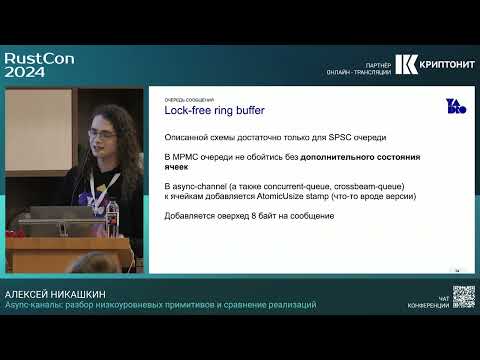
- 12:10MPMC queue details
- 15:18Unbounded queues
- 18:25Task notifications
- 21:12Storing task handles
- 22:36Tokio vs Channel vs Flume
- 25:06Switch to Channel
- 26:50Key takeaways
- 28:14Q&A