Keynote: Simple goal. Hard to accomplish

summary
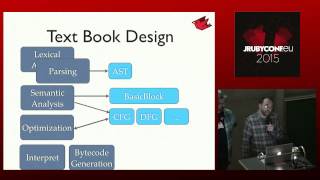
Goal is to make Ruby three times faster under the constraints of backward compatibility, low memory footprints and no fragile third‑party dependencies. Work builds a new register‑based IR (register-based LTL) and a JIT that emits C and uses GCC AOT compilation to produce shared objects, enabling dynamic or ahead‑of‑time loading. Prototypes (the MJ JIT) show roughly 3× speed on realistic Rails and Optcarrot‑style workloads, at the cost of higher memory use but still lower than many JVM JITs; microbenchmarks report even larger gains.
AI-written summary · about
chapters (12)
- 0:00Setting goals for software
- 1:06The importance of stability
- 4:10Lessons from breaking changes
- 8:01The Ruby 3x3 initiative
- 10:37Constraints and regulations
- 17:56Measuring performance
- 20:26Standardizing benchmarks
- 24:31Introducing JIT technology
- 30:27Register-based architecture
- 35:54The MJIT implementation
- 41:30Future and conclusion
- 44:42Q&A session