Microfrontends

summary
Case study of migrating a large Backbone/Java monolith to independent microfrontends that deliver real outcomes not platitudes: they split by domain, run each microfrontend with Node/React/TypeScript starter kit plus Express APIs and nginx routing on Kubernetes + nginx routing, move shared code into NPM packages and a mono repo, cut end‑to‑end runtime from 4–5 hours → 20–30 minutes, and enable daily deploys with team ownership while still wrestling with dependency bloat and stitching/SEO problems.
AI-written summary · about
chapters (31)
- 0:00Intro
- 0:33"old" situation
- 1:09challanges
- 1:23tighly coupled
- 1:47release cycle
- 2:07testing
- 2:30big plans
- 2:57current application not future proof
- 3:18what business value can we add?
- 3:32time to market
- 4:17performance
- 4:29modern technologies
- 4:58freedom
- 5:22rebuild step by step
- 5:37meanwhile...
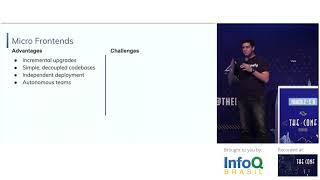
- 6:15Micro frontend architecture is an approach to developing web application as a composition of small frontend apps.
- 6:40Instead of writing a large monolith frontend application, the application is broken down into domain specific micro frontends, which are self- contained and can be developed and deployed independently.
- 6:52what is a domain?
- 7:18one team per domain
- 7:28account
- 7:45microfrontend architecture
- 11:16advantages
- 11:38domain knowledge
- 12:03deployments
- 12:49other improvements
- 15:08demo
- 21:01challenges
- 21:31breaking down the silos
- 21:55global changes
- 22:12bundle size
- 22:57stitching layer
related talks
 33mMicro frontends: Unbelievably True Life Story
 25mMicro Frontend: a microservice architecture from your frontend web apps
 41mMicro-frontends: the golden circle
 31mMigrating from Monolith to Microfrontends
 48mMicrofrontend Architecture – technical implementation.
 21mMicro-frontends: 3 years ago
 47mMicro Frontends Unmasked
 36mMicrofrontends: Scalability Savior or Unmanageable Maze?