Keynote: The Future of Ray

summary
Community grows from a handful to over 350 contributors from 75 companies, and the release of Ray 1.0 locks core API stability while adding automatic distributed memory management and a stable Java API plus Windows array support. Core innovations are actor handles (any actor or task can call any actor), serverless autoscaling that picks instance types for CPU/GPU needs, and placement groups for atomic multi-node resource reservations; Horovod integration reportedly took ~400 lines and latency compares ~220 μs (gRPC) vs ~190 μs (Ray).
AI-written summary · about
chapters (7)
- 0:00Welcome and community growth
- 1:27Ecosystem and integrations
- 4:14Why Ray excels for distributed apps
- 7:44Ray 1.0 and stability
- 9:52Serverless experience
- 11:15Placement groups explained
- 12:18Future roadmap and thanks
related talks
 11mKeynote Q&A
 37mEvolving Ray Core: Scalability, Reliability, and Compiled Graphs
 23mImproving Ray for Large-scale Applications
 27mEvolving and Scaling Ray for the Next Generation of AI Workloads
 15mRay: A Distributed Compute Engine for AI
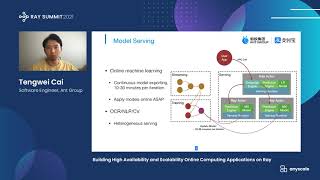 14mBuilding High Availability and Scalability Online Computing Applications on Ray
 24mRay: A System for High-performance, Distributed ML Applications
 28mA Deep Dive into Ray’s Scheduling Policy