Recent Progress in Quantum Advantage

summary
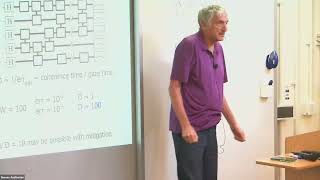
Argues that useful exponential quantum advantage needs three things at once: NISQ-able hardware, a clear classical hardness gap, and an efficiently verifiable output. Cites sampling experiments (Google random-circuit work with 53–60 qubits and USTC boson sampling with ~100 photons) where circuit depth is ~20 and verification uses the linear cross-entropy benchmark, yet classical tensor-network spoofing and improvements in simulators erode claims. Notes gate fidelity tradeoffs (99.5% vs 99.9% gate fidelity) and resource estimates (earlier million‑depth simulations down to thousands), and highlights Yamakawa and Jandry’s new oracle-based exponential speedup that still looks impractical for NISQ.
AI-written summary · about
chapters (19)
- 0:00Opening remarks
- 1:25Pandemic reflections
- 3:01Workshop overview
- 4:46Introduction to speakers
- 6:27Quantum advantage talk
- 11:10NISQ era challenges
- 12:56Requirements for speedup
- 19:12Supremacy experiment status
- 23:30Verifiability issues
- 29:16NISQ algorithms review
- 32:05Future directions
- 34:06Adiabatic algorithm
- 38:09Verifiable speedups
- 44:38Oracle separations
- 47:28Yamakawa-Zandry results
- 51:51Future experiment design
- 58:37Geometric complexity
- 1:05:12Conclusion
- 1:07:06Q&A session
related talks
 01h 08mPutting Quantum Supremacy on a Rigorous Footing
 59mUtility, Computational Cost, and Effective Quantum Volume of NISQ Experiments
 45mClassical Verification of Quantum Computational Advantage
 24mQuantum Computing: a Treasure Hunt, not a Gold Rush
 02h 42mQuantum Computing Exposed: Deep Dive
 28mThe Problem with Qubits
 48mStatistics In Quantum Computational Supremacy
 19mAn Industry Perspective on the Path Forward in Quantum Optimization