Admiral-Driven ML Framework for Marine Operations

summary
Claims an IRL-based metric learning pipeline recovers admiral-level reward functions from demonstrations plus AB-style preference comparisons and sparse annotations, then feeds those rewards into constrained multi-objective optimizers balancing fuel, mission success probability and platform survivability. Implementation uses a simple alpha/beta/gamma loss combining hard constraints (rule checks) and soft preferences, occasional PyTorch components, manual sequential decomposition, iterative preference-refinement loops and off-policy plus deep reinforcement learning for generalization. Results show linear solvers often suffice, hybrid human-in-the-loop alignment reduces surprising unsafe behaviors, and safety gates plus active learning mitigate data sparsity.
AI-written summary · about
chapters (13)
- 0:00Introduction
- 1:13AI challenge for admirals
- 3:00AI solutions vs admirals
- 6:15Maritime AI challenges
- 8:02Six steps to model building
- 11:13Admiral preference concept
- 13:46Explainability importance
- 16:40Complex loss function
- 18:04Admirals and the Pentagon
- 20:15Feedback loop and solution assembly
- 22:45Model training in practice
- 24:30System safety and reliability
- 26:47Summary
related talks
 47mAligning ML objectives with human values
 41mFrom Lab To Life: Practical AI System Evaluation
 14mHuman-in-the-Loop Reinforcement Learning
 12mThe AI Trust Triad for DevOps
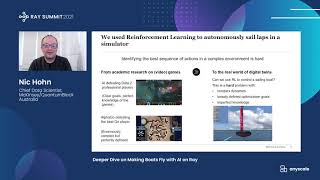 28mDeeper Dive on Making Boats Fly with AI on Ray
 19mLessons from Trillion Token Deployments at Fortune 500s
 44mThe ML Mindset for Managers
 33mBuilding Resilient (ML) Pipelines for MLOps