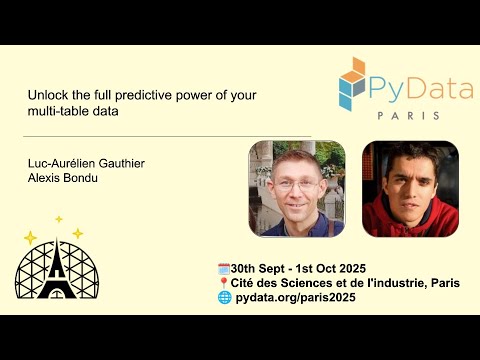
Unlock the full predictive power of your multi-table data
summary
Claims an automated, supervised feature-engineering system for raw multi-table data and ships as open-source Python library KOPS. Describes an MDL-based formalism that penalizes aggregate complexity so no hyperparameter tuning is required, discretizes numericals optimally, selects parsimonious features, and resists overfitting. Shows a demo on open government crash data, reports ~50× faster than Google AutoML with far fewer resources, produces interpretable reports and a small final model built from many candidate aggregates.
AI-written summary · about
chapters (19)
- 0:00Multi-table data challenges
- 1:08Structured data enterprise value
- 2:12Hidden complexity of datasets
- 3:59Data science automation limits
- 5:45LLMs fail with multi-table data
- 7:33KOPS for automated pipelines
- 8:39Supervised KOPS pipeline
- 10:03Auto feature engineering
- 12:37Optimal encoding and discretization
- 17:33Auto feature engineering without overfitting
- 18:59Live demo: car crash dataset
- 21:55KOPS scalability benchmarks
- 23:00Interpreting KOPS reports
- 24:25Future LLM pipeline integration
- 25:09Q&A: task types and algorithms
- 26:35Optimal binning in KOPS
- 27:39Bayesian formalism behind KOPS
- 28:25Bayesian modeling in KOPS
- 30:20Q&A: latent space projections
related talks
 01h 25mUnlocking the Predictive Power of Relational Data with Automated Feature Engineering
 31mIn-database machine learning: Automate, scale, deploy
 22mPredict the future (or don't) with machine learning in applications
 27mFrom Data to Insights in Minutes: Accelerating Predictive Modelling (in Python) with AutoML
 19mAccelerating ML Development with Multi-Modal Datasets: Python, Parquets, and Daft
 29mOpeningTheBlackBox
 37mTaming the Data Tsunami
 15mOperationalizing Predictive Analytics in Education