CART: Not only Classification and Regression Trees

summary
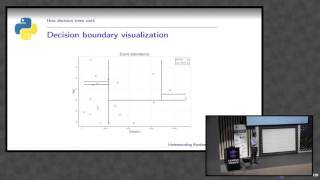
Decision trees are simple but practical: a Python implementation that builds axis-aligned splits, uses min_samples_leaf=4 and max_depth to avoid overfitting, and yields empirical class probabilities from leaf frequencies. Logistic regression is orders of magnitude faster for prediction, but trees give built-in feature selection, easy visualization and per-sample debugging. Random forests add stability. Examples include scatter visualizations, a custom tree-plot routine and case studies showing where trees overfit, when preprocessing matters, and when the approach actually improves decisions.
AI-written summary · about
chapters (19)
- 0:00Decision trees in practice
- 2:32Party attendance prediction
- 7:10How trees split data
- 11:01Overfitting and growth control
- 14:33Performance vs linear models
- 16:40No standardization needed
- 17:45Automatic feature selection
- 19:50Debugging with decision trees
- 23:23Categorical variables & missing values
- 25:06Bias and preprocessing
- 26:53Trees vs linear models on imbalance
- 27:56Stability and debugging
- 28:58Random forests for stability
- 30:48Best split selection
- 34:18Split quality: entropy & gain
- 35:42Beyond classification
- 37:07Probability estimation
- 38:33Regression with decision trees
- 39:17Strengths and weaknesses
related talks
 06mPërdorimi i Decision Trees dhe të dhënat për të marrë vendime
 35mUnderstanding, Simplicity, And Decision Trees
 43mIt's Not Magic: Explaining Classification Algorithms
 44mUnderstanding Random Forests
 32mThe Dangers of Mindless Forecasting
 27mUsing Random Forests in Python
 57mFrom Bonsais to Random Forests
 09mDecision forests in TensorFlow