Discover semantic topics in a collection of documents

summary
Uses transformer embeddings (a Sentence-BERT multilingual model) plus sentence-transformers for document vectors, reduces dimensions with UMAP + HDBSCAN clustering, and labels clusters with class-based TF‑IDF via the BERTopic pipeline. Applies to 2020 regional reports for Tillväxtverket, discovers ~300 granular topics and highlights seven dominant ones (transport, pandemic, hospitality, equality, funds, food, cooperation), compresses vectors to as few as five dimensions, produces interactive Streamlit visualizations, and notes preprocessing needs and evaluation by coherence/diversity metrics.
AI-written summary · about
chapters (10)
- 0:00Introduction and speaker intro
- 2:22What is topic modeling
- 6:02Transformer-based language models
- 15:55Neurotopic modeling method
- 25:08Case study with Swedish reports
- 33:14Sharing results with Streamlit
- 34:18Measuring topic model performance
- 38:31Applications of topic modeling
- 39:37Caveats and tips for topic modeling
- 44:00Q&A session
related talks
 27mUnveiling Clustering in BERTopic Topic Modeling
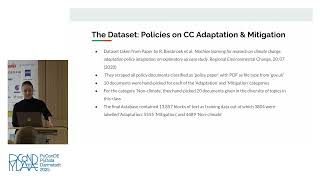 45mDecoding Topics: A Comparative Analysis of Python’s Leading Topic Modeling Libraries Using Climate C
 38mData Mapping for Data Exploration
 31mWhen humans teach machines
 20mApplying Computational Analysis to Textual Data from the Wild: a Feminist Perspective
 03mContextual understanding using Generative Artificial Intelligence
 28m"Embeddings: How Computers Learned to Read"
 31mBeyond Vectors: Evolving GenAI through Transformative Tools and Methods