Artificial Information: How Today's AI is Changing Information
summary
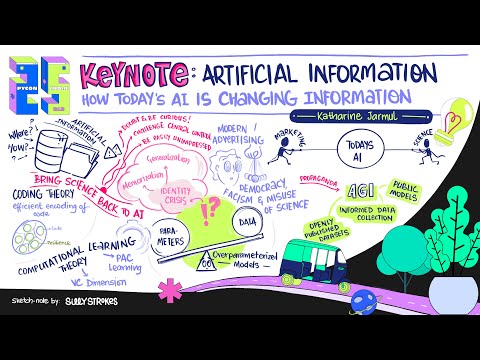
Argues that current AI turns murky, poorly governed datasets into proclaimed facts — cites ICE linking disparate records to deport people and Google Gemini’s false Nazi imagery as harms; explains overparametrized models (GPT sizes) memorize rare examples with Zhang et al.’s identity experiments showing deep layers perfectly store a single digit; highlights concrete fixes: AI for Bharat crowdsourced speech/text datasets, local LLMs like Ollama and GPT4All run over LAN, and privacy-by-design stacks using SGD with differential privacy and private secure aggregation (basis for Google’s implementation).
AI-written summary · about
chapters (18)
- 0:00Introduction and speaker welcome
- 0:44Defining artificial information
- 3:42Information theory basics
- 8:42From embeddings to AI models
- 10:49Overparametrized models explained
- 15:49AI and power structures
- 20:10Worldviews in AI systems
- 23:26Ethics and AI therapy
- 24:52AGI and propaganda concerns
- 25:57AI for Bharat initiative
- 27:04Public AI models and transparency
- 28:08Local AI and community learning
- 30:19Federated and collaborative learning
- 31:24Private learning with differential privacy
- 33:09Bringing science back to AI
- 34:39Emotional manipulation in AI
- 36:44Decentralizing information control
- 37:50Call to action and conclusion