Anonymity in the Bitcoin Peer-to-Peer Network
summary
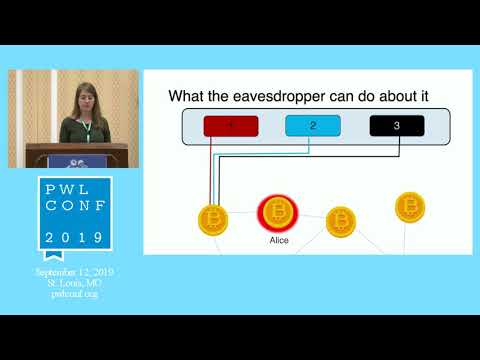
Researchers reproduce 2014 attacks that use many eavesdropper connections (they run up to 50) and show 11–34% of users de-anonymized by pointing at the first reporter; switching Bitcoin from trickle to diffusion does not reduce deanonymization. A new protocol Dandelion sends transactions along a short anonymity line then diffuses, achieving worst‑case recall ≈ P and precision near P^2 log P, adds about 2 seconds latency for 10‑hop lines, and is implemented as a BIP and in Grin and Beam.
AI-written summary · about
chapters (13)
- 0:00Introduction to talk
- 0:29Bitcoin anonymity myths
- 1:56How Bitcoin transactions work
- 3:20Privacy risks in Bitcoin
- 6:11Network-level anonymity attacks
- 7:14Early peer-to-peer deanonymization
- 11:27Bitcoin Core’s protocol change
- 13:15Theoretical analysis of diffusion
- 24:27Introducing Dandelion solution
- 27:39Dandelion’s privacy guarantees
- 35:05Designing Dandelion protocol
- 41:42Dandelion’s performance and adoption
- 45:55Takeaways and conclusion