Privacy is Sooner Than You Think

summary
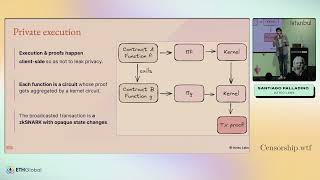
Company pivots from TradFi tooling to a private programmable L2 that actually runs private state and account abstraction, claims client-side proving and recursion workarounds make recursive SNARKs practical, and uses Plonk and Noir as core tools. A sandbox release is imminent to test private contracts and client-side proof performance, with a roadmap targeting a 2025 mainnet launch. Concrete numbers and benchmarks are sparse but recursion and sequencing tradeoffs are presented as solved engineering problems.
AI-written summary · about
chapters (22)
- 0:00Intro to Zac Williamson and Aztec
- 0:46Origins of Aztec and early goals
- 1:42Realizing the need for privacy on-chain
- 3:20The problem with trusted setups and early limitations
- 5:01Sonic paper and the path to universal SNARKs
- 6:05What is Plonk and how does it work
- 8:56From Aztec 1.0 to Aztec 2.0
- 10:27Why Aztec focused on private rollups
- 11:30Recursion challenges in private rollups
- 13:05Why recursive proofs are hard to verify
- 14:06Building composability through recursion
- 15:35Why Aztec didn’t choose ZK-EVM
- 16:42How private state changes break EVM assumptions
- 18:03What private smart contracts look like
- 19:04Account abstraction with privacy and Web2 logins
- 21:03Using Noir to build private smart contracts
- 22:39Lessons learned and what surprised Zac
- 24:26What is Aztec 3.0 and what it enables
- 25:39Timeline to Aztec sandbox and mainnet
- 26:45Predicting Ethereum scalability in two years
- 27:44Sequencer decentralization trade-offs
- 28:47Closing thanks and Aztec’s future