Why is PostgreSQL Terrible?
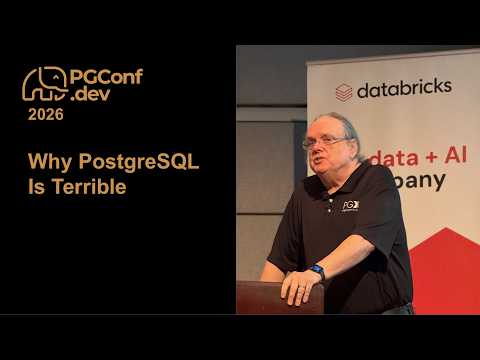
summary
Field report of operational failures: autovacuum's autovacuum thresholds miss on big tables (at ~2 TB it waits until ~200 million dead tuples), causing destructive, IO-saturating runs; running create index concurrently can stop a busy system; logical replication is fragile and can require expensive resyncs; pg_upgrade stalls on thousands of objects (one shop had 375,000 tables), leaving a 15 TB cluster stuck on 9.4; sudden query plan flips turn 10 ms queries into 200 ms; connection churn with 5,000 max connections forces fleets of PG bouncers.
AI-written summary · about
chapters (17)
- 0:00Introduction and speaker background
- 1:28Why PostgreSQL isn't perfect
- 3:54Operational complaints vs. features
- 5:00Autovacuum struggles and tuning issues
- 8:15Vacuum IO and performance impact
- 10:22Replication and query cancellations
- 12:50Logical replication fragility
- 14:14Query planner and plan flips
- 17:43Need for query hints
- 19:28Query guidance and planner improvements
- 21:33Upgrade challenges and pg_upgrade
- 24:59Connection pooling and scalability
- 27:48Monitoring and logging limitations
- 30:36High availability out of the box
- 33:50Scaling beyond read replicas
- 36:19Conclusion and call to action
- 37:01Q&A session