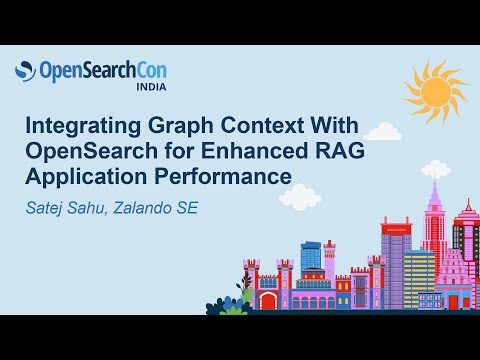
Integrating Graph Context With OpenSearch for Enhanced RAG Application Performance
summary
Architecture that merges a graph layer with an OpenSearch vector index to ground RAG using travel-app synthetic data, either by querying a separate graph DB (Neo4j/Neptune) or by storing OpenSearch vector index as metadata triplets (from, relation, to). Claims safer, more personal results: measured recall 71%→86% (+21%), mean response time 53ms→64ms (+11%), tokens per prompt down from ~3200 to ~800 with graph-only; approach exists as a prototype (not production), warns on NER errors, caching and observability needs.
AI-written summary · about
chapters (12)
- 0:00Graph-enhanced RAG intro
- 1:24Graph databases in AI
- 2:28Traditional RAG limitations
- 4:36Graph layers for RAG context
- 9:37RDF triples and knowledge graphs
- 12:52Graph context with OpenSearch
- 17:57OpenSearch as graph layer
- 22:35Performance impact of graph RAG
- 25:47Lessons from real implementations
- 28:16RAG accuracy best practices
- 30:27Future of graph-enhanced RAG
- 31:10Q&A
related talks
 39mEnhancing RAG with Neo4j Knowledge Graph
 30mGraph RAG: Bringing together graph and vector search to empower retrieval
 16mEnhancing Retrieval-Augmented Generation with GraphRAG Patterns in Neo4j
 37mBuilding advanced RAGs with Elasticsearch OpenSearch
 17mFine-Grained Authorization for Secure RAG With OpenSearch
 34mImplementing an open-source RAG with OpenSearch
 13mOptimizing Real-Time Job Matching: Integrating Neo4j With RAG
 23mMeasuring the Performance of VectorRAG vs GraphRAG