Running Sovereign Cloud Stack Cluster for International Telecommunication Union: Lessons Learned

summary
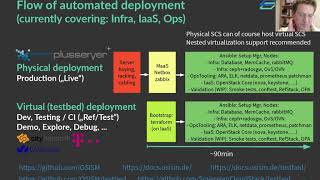
Sovereign Cloud Stack cluster for the International Telecommunication Union uses Kubernetes plus OpenStack (YaoK and ARCO components) to run GPU workloads with NVIDIA H200 GPUs, a bonded 200 Gbit/s leaf‑spine network, and ~1 PB of NVMe/remote storage (local NVMe RAID5 + fast networked storage + cold backups). Identity integrates Microsoft Entra ID via Keycloak, VPN uses Tailscale, ingress uses Envoy/Contour, and custom OpenStack reporting (Rax stack) supports ops; the team reports successful deployment and handover, delivered in 2 weeks.
AI-written summary · about
chapters (9)
- 0:00Sovereign Cloud Stack intro
- 2:33Telecom cluster requirements
- 7:57Avoiding vendor lock-in
- 9:44Fast network & storage
- 13:15Kubernetes + OpenStack with Yaook
- 18:15K8s as a service at scale
- 23:17Sovereignty & open ops lessons
- 24:42Deployment challenges
- 25:25Q&A
related talks
 17mSovereign Cloud Stack Technical Deep Dive
 34mSCS: Buildig Open Source Cloud and Container Infrastructure
 21mBack to the original mission: an open cloud operating system
 42mThe Challenges and Solutions of Open Edge Infrastructures
 31mAn Open Source Telco Cloud Stack to Accelerate the Adoption of Cloud Native Operator Model
 17mLessons learned: scaling confidential clusters on OpenStack
 43mSupporting NASA Science with OpenStack
 01h 15mContinuity on the Path to Digital Sovereignty - European Initiatives in Focus