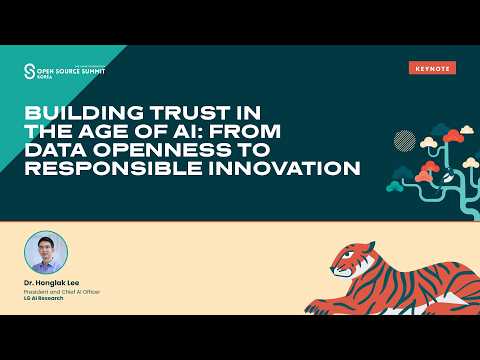
Building Trust in the Age of AI: From Data Openness to Responsible Innovation
summary
LG AI Research reports building Korea’s sovereign foundation models (XL1 to XL1 4.5) and says trust hinges on dataset provenance, not just architecture or weights. A KAIBOM profile on SPDX 3.0 records model, dataset, and training-data lineage as a verifiable graph. Tracing 2,852 “commercial” datasets uncovers only 605 actually safe (21%) after upstream inspection. An agent that walks the chain automates the labor: 45× faster and 26% more accurate than human baseline, producing machine‑readable AI BOMs that move with models.
AI-written summary · about
chapters (16)
- 0:00Building trust in AI
- 1:26Trust harder than performance
- 2:11AI black box limits
- 3:19Three links of AI trust
- 4:02AI Bill of Materials
- 5:07Provenance for transparency
- 6:40Missing link in transparency
- 8:09KAIBOM Korea’s AI BOM
- 9:14Tracing data lineage essential
- 10:19FineVision data origins case
- 11:46Open datasets safety
- 12:52AI training data transparency
- 13:13Full data lineage openness
- 13:53AI agents for lineage tracking
- 15:19AI BOM chain of trust
- 16:02Conclusion
related talks
 37mIs Your AI Truly Open ? Cutting Through the Hype
 34mTrust in the Age of AI Agents | Building Trustworthy AI
 11mKeynote: Trusted AI: Bringing Trust Back into AI through Open Source
 39mA Hopeful View of Truly Open Source AI
 45mEstablishing Trust in AI: Blockchain
 31mMaking Trustworthy AI a Business Advantage
 16mTrust by Design: Building Reliable AI for Sensitive Environments
 46mCan you trust your AI?