The Way of Cloud Native AI
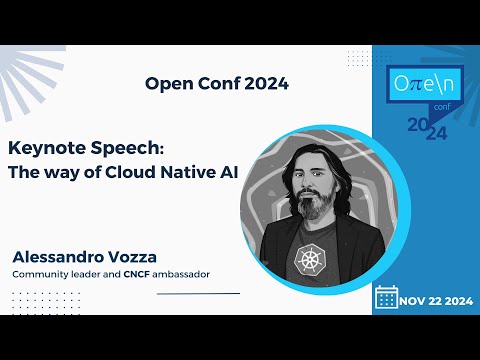
summary
Argues that Kubernetes and cloud-native tooling are practical enablers for AI workloads, citing KubeFlow pipeline + TensorFlow/Jupyter as a one-click install path for training, inference and experiment tracking; highlights sustainability with a claim of roughly ≈5 g CO2 per prompt and large water cooling costs tied to GPU datacenters; demos show WasmEdge running Llama-3 2.1B instruct locally and a KGPT utility that pulls cluster manifests, calls OpenAI, and pinpoints an image-name typo (engine x → nginx), returning actionable remediation suggestions.
AI-written summary · about
chapters (13)
- 0:00Introduction and welcome
- 1:50Cloud native and Kubernetes basics
- 8:16AI revolution and large language models
- 13:58Cloud native definition and history
- 18:16AI workloads on Kubernetes
- 21:27AI and Cloud native synergy
- 23:56CNCF AI working group
- 25:22Kubeflow and AI tools
- 26:50WebAssembly for AI workloads
- 28:39Demo: Running LLM with WASM
- 29:22Demo: KGPt troubleshooting
- 31:10Platform engineering and sustainability
- 32:16Q&A session