Homeostasis: Design and Implementation of a Self-Stabilizing Compiler (TOPLAS)

summary
Homeostasis is a compiler framework that automatically captures program changes into a centralized compressed log, triggers stabilization on demand, and provides a formal correctness proof; it is implemented in IMOP for OpenMP C and requires no extra stabilization code in analysis or optimization passes. Evaluation across 24 benchmarks finds seven critical program abstractions, 84 naive change points (70 after pruning), and up to 30.64× speedup with lazy stabilization and incremental updates, while reducing manual stabilization burden.
AI-written summary · about
chapters (11)
- 0:00Homeostasis compiler design
- 1:45Unstable program abstractions
- 3:53Homeostasis solution benefits
- 5:17Elementary transformations and getters
- 7:02Stabilizer templates and modes
- 8:28Implementation tasks for writers
- 9:55Evaluation setup and benchmarks
- 12:41Manual stabilization challenges
- 13:44Performance results and speedups
- 14:48Conclusion and future work
- 15:55Q&A
related talks
 53mLocknote: How Badly Do We Want Correct Compilers?
 22mCompilers should get over themselves and respect semantic dependencies!
 14mOn-Stack Replacement for Program Generators and Source-to-Source Compilers
 53mFrom Within: Compiler Testing and Validation via Compilers
 47mHow an Optimizing Compiler Works
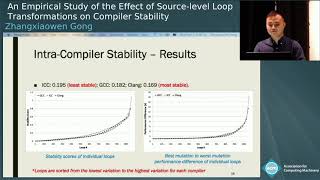 25mAn Empirical Study of the Effect of Source-level Loop Transformations on Compiler Stability
 31mPyrosome: A Framework for Modular, Extensible, Equivalence-Preserving Compilati...
 59mCompiler-assisted Translation Validation