Projection-Based Runtime Assertions for Testing and Debugging Quantum Programs

summary
Proposes projection-based assertions that express quantum-state predicates more richly than classical patterns while enabling efficient runtime checks by repeating a projective measurement: the miss rate falls as (trace(p rho))^k so few repetitions catch blatant bugs, and assertions that pass do not disturb the state. Provides three concrete fixes for hardware limits — diagonalize to computational basis, intersection decomposition, and the auxiliary qubit trick — plus algorithms, simulations and proofs showing the approach is implementable and practically useful.
AI-written summary · about
chapters (17)
- 0:00Intro
- 0:15Quantum programming is error-prone
- 0:57To improve the program reliability
- 1:34What is an assertion?
- 2:11Test a quantum program state
- 3:43Projection: definition and property
- 4:34Why using projections
- 5:36Benefits of projections
- 9:33Projection-based assertion primitive
- 9:59Multiple assertions per execution
- 10:33Practical implementation issues
- 10:54Practical constraints
- 11:53Transformation techniques
- 14:33How to apply those techniques
- 14:44What about automation?
- 15:05Local projection
- 15:18Summary
related talks
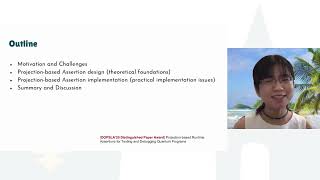 32mTheory, Design, and Implementation of Projection-based Assertions for Quantum Debugging
 23mA Unified Assertion-Based Framework for Classical-Quantum Program Verification
 41mQuantum Abstract Interpretation
 42mQuantum program analysis: Verification and Testing
 27mAn Expressive Assertion Language for Quantum Programs
 30mOn incorrectness logic for Quantum programs
 13mQbC: Quantum Correctness by Construction
 22mQbC: Quantum Correctness by Construction