Beyond the Screen: How Embodied Manifestations of AI can Amplify People in the Physical World

summary
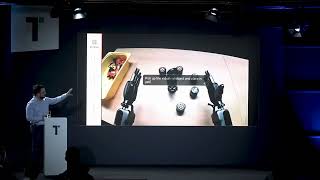
Claims that diffusion policies learn robust robot behaviors from only 60–100 demonstrations, producing policies that outperform single‑task models and form the backbone of a large behavior model that generalizes across tasks and even onto an Atlas humanoid (Boston Dynamics). Demonstrations include a trained robot unrolling a mat, two cars performing two autonomous cars drifting at expert human levels, Apex Trainer that analyzes telemetry to coach drivers, and a baseball coaching pipeline using motion capture for the Red Cruisers.
AI-written summary · about
chapters (14)
- 0:00Embodied AI and Toyota's mission
- 2:09Virtual AI vs physical assistance gap
- 3:55Embodied intelligence in Toyota machines
- 6:00Skepticism toward embodied AI
- 8:06Jidoka: Human-centered automation
- 10:37Teaching robots with diffusion policies
- 13:00Large behavior models for robots
- 15:45Embodied AI teaching human skills
- 17:29Autonomous drifting benchmark
- 19:39Rethinking driver-car AI relationship
- 22:31Apex Trainer: AI driving tool
- 24:17AI for sports coaching
- 26:23Intelligence amplification paradigm
- 27:46Q&A
related talks
 18mRobotics: why now?
 17mBeyond Automation: AI and the Evolution of Robotic Intelligence
 18mPhysical AI — When AI Leaves the Digital World
 32mThe Road to General AI
 52mPhysical AI: Crafting Resilient Systems with Emotional Intelligence
 01h 35mDeep Robotic Learning
 42mAI & Human Decision Making
 35mHow The AI Institute is Revolutionizing Robotics ML Training