From the Ball-proximal (Broximal) Point Method to Efficient Training of LLM
summary
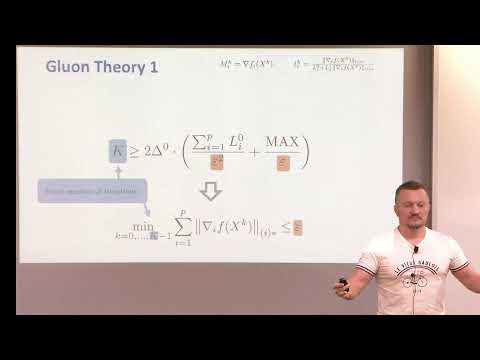
Proposes the Ball-Proximal (Broximal) Point Method as a ball-constrained analogue of proximal methods and proves surprising guarantees: linear convergence and finite termination for nonsmooth convex problems, extendable to non‑Euclidean norms. Shows practical approximations—layerwise LMO minimization and momentum—that recover Muon/Scion behavior (Muon uses ~five Newton–Schulz orthogonalization steps) and yields theoretical step sizes matching tuned values; measures layerwise smoothness constants mostly between 1 and 100 and validates faster wall‑clock training (NanoGPT, CNN) with compression and error‑feedback.
AI-written summary · about
chapters (6)
- 0:00Welcome
- 9:49Broximal point method
- 22:49Broximal convergence
- 31:40Theory to Muon optimizers
- 43:43Muon foundations
- 51:03Broximal in federated learning
related talks
 46mSmooth Nonconvex Min-Max Optimization
 51mAre Single-Loop Algorithms Sufficient for Unbalanced Minimax Optimization?
 42mOptimization Crash Course
 01h 18mOptimization I
 12mEquilibrium Computation and the Foundations of Multi-Agent Machine Learning
 01h 01mML for discrete optimization: Theoretical foundations
 01h 00mMin-Max Optimization from a Dynamical Systems Viewpoint
 01h 05mTutorial: Federated Optimization, Part III