Monoids on Steroids: A Brief History of FP
summary
A hobby project called plotting and scheming implements a fractal-and-plotter suite (complex plane, L‑system, vector, polar, cartesian) written in F# with an embedded lazy Scheme interpreter so users change equations at runtime; the naive interpreter runs surprisingly fast compared to a native implementation and handles per‑vector evaluation. The narrative traces concrete milestones (Boole, lambda calculus, Lisp, Haskell, monads) and claims monads make FP viable in practice, notes F#’s pragmatic impurity and ties into tooling like type providers.
AI-written summary · about
chapters (23)
- 0:00Intro
- 0:22Quote
- 1:02No Mutation
- 2:561847: Propositional Logic
- 3:321924: Combinatory Logic
- 5:451937: Boolean Algebra
- 6:201942: Category Theory
- 7:221958: LISP
- 9:251972: Prolog
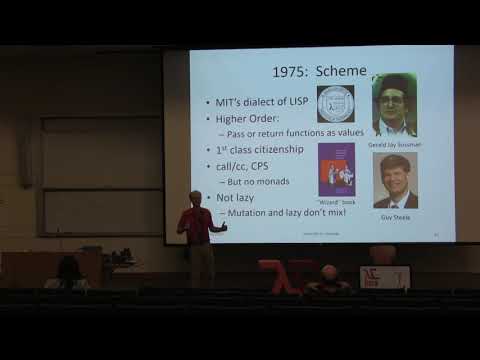
- 10:051975: Scheme
- 11:071983: Symbolics
- 12:191987: Haskell
- 13:281992: monads
- 13:451998: XML
- 16:01Impedance mismatch
- 16:38Rosetta Stone
- 17:03Discriminated Unions
- 17:18Haskell example
- 18:02Vector Fractals
- 18:24Mandelbrot Peano Curve
- 21:44Complex plane
- 22:38Conclusions
- 23:59Addendum
related talks
 31mAbstract nonsense
 38mMaths for Programming, Fun, and Creativity
 36mF# for Fun and Games
 49mFunctional geometry: picture combinators and recursive fish
 20mDemo: New View on Plasma Fractals -- From the High Point of Array Languages
 48mComposition by Juxtaposition: A PostScript on Functional Geometry
 26mUsing Functional Reactive Programming for Robotic Art
 40mPhysics in Clojure