Building a raytracing engine with JavaScript

summary
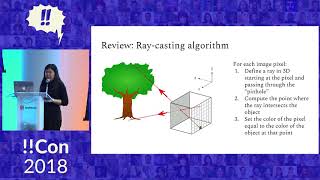
Builds a JavaScript ray tracer step by step, showing the sphere intersection test, a recursive trace function with depth limiting, and how reflection and refraction combine into pixel color. Compares results to rasterization, points out which effects come “for free” (soft shadows, reflections) and which require many samples. Demonstrates an A-Frame scene for fast WebVR/rasterized results, loading models from Google Poly, and light baking (precomputed ray‑traced lightmaps) for realistic browser renderings.
AI-written summary · about
chapters (10)
- 0:00Intro
- 0:40Hi, I'm Madlaina
- 7:36Materiality
- 12:11Capturing an image on camera
- 14:17Let's look at some code
- 22:46Complexity
- 23:07Rasterization
- 25:583D rendering techniques
- 28:39A-Frame components
- 30:183D Content
related talks
 28mBuilding a ray tracing engine with JS
 59mYou can't do that with JavaScript!
 50mIt's So Shiny! A Pure JavaScript Ray-Tracer
 49mTracing Rays in Real Time
 31mWelcome to 3D
 12mRay-tracing and special relativity: Rendering objects near the speed of light!
 31mWebGL: Building Interactive 3D Worlds in the Browser
 17mBuilding Immersive Experiences on the Web