Understanding Contrastive Learning and Self-training
summary
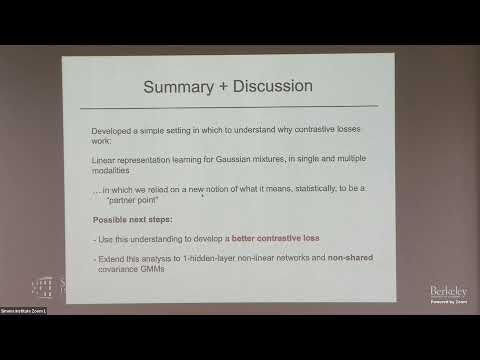
Analyzes InfoNCE on linear nets trained on a Gaussian mixture with an explicit augmentation model (pairs drawn from same component with probability delta). In the population limit and shared-covariance setting, optimizing InfoNCE yields a projection whose column space lies inside the Fisher subspace (if r ≥ K) and equals it when delta = 1; a CLIP-style multimodal loss yields the corresponding Fisher subspace in each modality. Separate result proves a simple self-training filter-and-retrain (remove examples where prediction disagrees with label, then retrain) strictly improves accuracy for linear classifiers on linearly separable data with label noise, with implications for recovering accuracy under label-privacy corruption.
AI-written summary · about
chapters (11)
- 0:00Introduction
- 2:32Contrastive learning overview
- 7:29Mathematical frameworks
- 12:35Motivation and methodology
- 15:01GMM background
- 18:28SVD vs. fisher subspace
- 20:37Fisher subspace analysis
- 25:42Defining augmentations
- 30:03Results for single modalities
- 36:46Multimodal GMM results
- 42:59Conclusion and future work
related talks
 17mSelf-Training Converts Weak Learners to Strong Learners in Mixture Models
 01h 02mTutorial: Statistical Learning Theory and Neural Networks II
 01h 31mUnsupervised Learning
 01h 18mUnderstanding Generalization from Pre-training Loss to Downstream Tasks
 51mEfficient Retrieval of Influential LLM Training Examples
 01h 30mToward Understanding In-context Learning
 01h 37mTutorial: Implicit Bias II
 59mStudying Failure Modes of Deep Learning and Ways To Fix Them