Evolving your APIs, a step by step approach

summary
Sets up an API gateway with Apache APISIX in Docker Compose, creates routes and named upstreams, and rewrites paths so legacy clients hit v1 while new clients hit v2. Adds monitoring with Prometheus and Grafana, uses a proxy-mirror traffic plugin to compare responses, and performs a 50/50 canary split by weighting upstreams. Implements auth and rate limits via a custom Lua plugin that checks API keys and returns redirects (301) and deprecation/sunset headers to migrate users.
AI-written summary · about
chapters (19)
- 0:00Intro
- 2:07Your first API
- 3:28The initial situation
- 4:09An API Gateway can help!
- 4:22But we have a reverse proxy
- 4:52Let's go back a bit
- 5:38My first website
- 10:22The rise of www
- 11:30www becomes ubiquitous
- 12:11The evolution of the Web Server
- 12:32Reverse Proxy: Single Point of Entry
- 13:03Interconnecting heterogeneous Information Systems
- 18:22Introduce an API Gateway
- 24:36Introduce a versioned resource
- 29:18Move the unversioned resource permanently
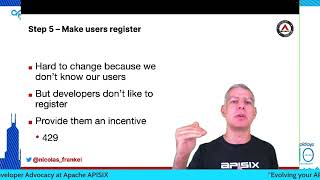
- 31:11Make users register
- 36:28Test in production but be smart about it
- 40:26Use proven deployment methods
- 42:04Deprecate your endpoints
related talks
 35mEvolving your APIs, a step-by-step approach
 44mEvolving Your APIs, A Step-By-Step Approach
 30mEvolving your APIs, a step-by-step approach
 41mEvolving your APIs, a Step by Step Approach
 38mEvolving your APIs, a Pragmatic Approach
 46mEvolving Your HTTP APIs: A Multi-Step Approach
 35mAPISIX, an API Gateway the Apache way
 42mEvolving Your HTTP APIs, a Step-by-Step Approach