What do autotests affect?
summary
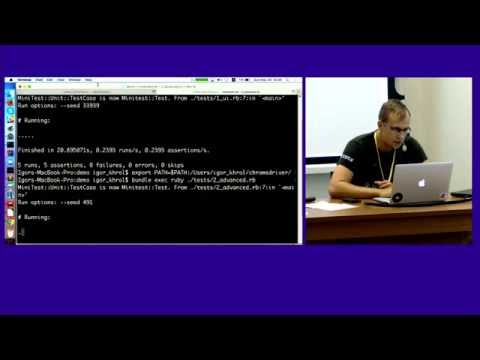
Shows concrete experiments in Ruby: a Selenium WebDriver browser test on Firefox takes ~70 tests per 5 minutes, switching to Chrome and tweaking IDs improves to hundreds, refactoring business logic out of views and controllers into a broker plus a JSON endpoint lets integration tests run thousands per minute and unit tests run orders of magnitude faster. Built examples include browser scripts, direct DB seeding, a broker class and unit tests, using Selenium WebDriver, Rails, and reaching 1.5 million tests in the demo, proving the speed gains actually work.
AI-written summary · about
chapters (14)
- 0:00Introduction and speaker background
- 4:31Autotests impact on projects
- 6:38Building a simple test project
- 9:07Automating manual test cases
- 14:10Speed limitations of browser-based tests
- 17:07Optimizing test execution speed
- 20:21Refactoring app for better testability
- 24:40Testing without browser overhead
- 29:13Architectural changes for test efficiency
- 33:14Removing database dependency
- 35:53Unit testing business logic
- 38:49Test automation pyramid explained
- 40:11Why automation projects fail
- 40:54Benefits of fast regression testing