Physical Side Channel Attacks On PCs
summary
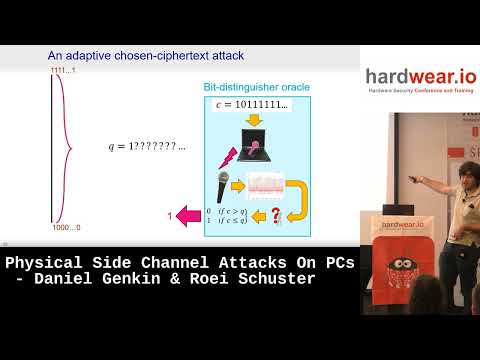
Physical electromagnetic and acoustic leakage from laptops is measurable as distinct spectral patterns (up to ~50 kHz) using a directional mic, parabolic dish or even a phone mic, and is tied to specific CPU operations (Katuba multiplication corner-case). A chosen-ciphertext bit-distinguishing oracle lets attackers recover RSA bits via amplified branching differences; ECDSA keys are recovered remotely by recording built-in microphones over VoIP, processing traces (band-pass, demod, downmix) and running a lattice attack after collecting ~20,000 signatures repeated 91×; website classification reaches ~94% accuracy for 14-way.
AI-written summary · about
chapters (20)
- 0:00Introduction to side channel attacks
- 1:09Acoustic side channel overview
- 2:09Measuring acoustic emissions
- 3:31Demo with ThinkPad T23
- 5:40Distinguishing CPU operations
- 6:45Extracting RSA keys acoustically
- 8:10Key transition detection
- 10:16Liquid self-amplification explained
- 13:29KATU multiplication flaw
- 16:37Live key extraction demo
- 17:20Using humans as antennas
- 18:43Remote acoustic attacks
- 19:47Transition to Rory's talk
- 20:10Remote side channels via microphones
- 21:53CPU leakage over VoIP
- 22:35Demo with Mumble VoIP
- 23:58Website fingerprinting attack
- 26:24ECDSA key extraction over VoIP
- 30:22Counter-Strike cheating exploit
- 32:29Q&A session