Streaming with DPDK: Raising the Throughput Ceiling with Drivers in Use..
summary
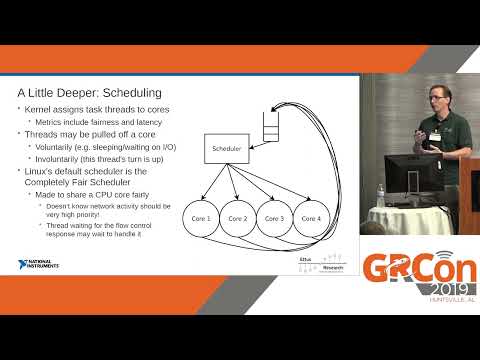
DPDK-based user-space drivers replace the kernel path with a minimal UDP/IP/ARP stack, pinned IO threads and zero-copy DMA buffers so the stream sustains the N320’s bandwidth at 250 MSPS per channel across 10GbE. Measured round trips drop from about 300 µs to about 80 microseconds latency, and UHD reaches full-rate two-channel TX without massive buffering. GNU Radio integration works but the thread-per-block scheduler becomes the new bottleneck.
AI-written summary · about
chapters (20)
- 0:00Introduction
- 0:40DPDK
- 1:50DPDK Architecture
- 2:25How DPDK Works
- 3:07Credit Based Flow Control
- 4:20Jitter
- 5:17Scheduling
- 8:04Kernel Defaults
- 9:23Affinity Control
- 10:10Drivers User Space
- 11:24DPDK Development Kit
- 12:24DPDK Support
- 12:40UHDPK
- 13:38Threading
- 14:14Configuration
- 14:47Latency Test
- 15:38Gnu Radio
- 16:25Thread per block scheduler
- 17:50Question Slide
- 18:08Questions
related talks
 19mWelcome & Opening Remarks
 28mRock around the clock (synchronization
 24mWhy do broadcasters suddenly care about IP - it’s not why you think!
 41mReal Time Architectures Real Fast
 25mScaling Up, One Network Bottleneck at a Time
 21mAI/ML Networking Challenges: The Fast and the Finicky!
 47mReal-Time Linux: What Is N...
 16mCDN Challenges of HTTP-based Low Latency Live Streaming Delivery