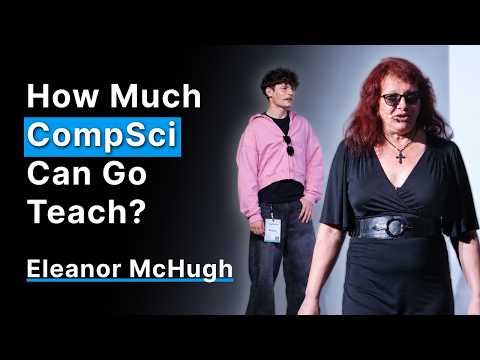
How Much CompSci Can Go Teach
summary
Argues that a teen who hated school Python becomes engaged by building a tiny Go project: a regex link extractor that reads pages as byte streams, uses anonymous functions for composition, runs concurrent fetches coordinated with sync.WaitGroup, and serves test pages with a simple HTTP test server so links can be validated. Code uses only the standard library, compiles and runs against live sites (Google/Bing) during development, and the repo and slides are available for follow-up.
AI-written summary · about
chapters (20)
- 0:00Introduction and perspective
- 1:55The nature of computer science
- 2:25Problems with school curriculum
- 3:12Limitations of learning tools
- 3:28Educational bias and research
- 5:34Practical programming challenges
- 7:06The role of AI in learning
- 7:53Educational inequality
- 8:36Bedroom coder culture history
- 9:50Modern coding and hardware
- 10:47Evolution of developer culture
- 11:53Project-based learning
- 14:20Software engineering foundation
- 15:05Parsing text with regular expressions
- 15:33Go library implementation
- 16:20Functional programming in Go
- 26:39Clarifying monads
- 27:05Refining the crawler project
- 28:22Concurrency and clean code
- 33:18Closing thoughts and outlook
related talks
 34mAnyone Can Be A Gopher!
 21m5 things I love (or why you should learn Go)
 30mComputer Science: The Good Parts
 33mFun, Friendly Computer Science
 18mHow Teaching Kids to Code Made Me a Better Developer
 30mLessons Learned: A Developer's Perspective on Teaching & Learning
 36mGo for the Rubyist
 01h 04mTeaching modern C++: is it a job or a mission?