OLAP on the Cloud with Azure Databricks and Azure Synapse
summary
Claims that adding a cloud OLAP semantic layer to Azure Synapse and Azure Databricks cuts query time from ~25s to under two seconds on a 10 TB TPC‑DS benchmark, and holds up at concurrency (25s → ~500s with Synapse alone; atScale reports 6x faster single‑user and 12x faster at 50 users). Implementation demos show live federated queries joining Synapse facts with Databricks Delta product tables, automatic materialization of a 606‑row aggregate and autonomous aggregates, Power BI/Tableau/Excel/Jupyter access, and cell‑level security and REST/JDBC/ODBC connectivity.
AI-written summary · about
chapters (33)
- 0:00Intro
- 1:40Agenda
- 3:55New Cloud Data Stack
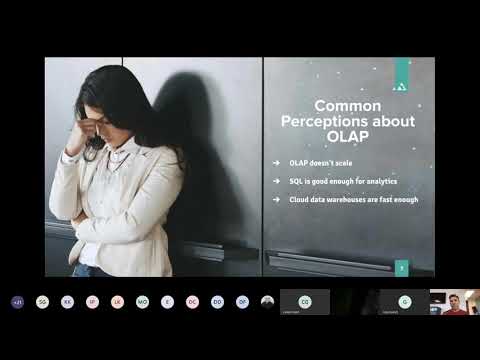
- 6:17OLAP Perceptions
- 8:21Why OLAP
- 10:17Subsecond queries
- 13:20Universal Semantic Layer
- 14:31What is life without a Semantic Layer
- 15:54Machine Learning Example
- 18:10Business Language
- 18:38Why Use OLAP
- 22:01Legacy OLAP Tools
- 22:39Cloud OLAP
- 24:58Demo Overview
- 30:03Defining Data Sources
- 31:43Demo
- 32:51Metrics
- 33:33Dimensions
- 36:21Query
- 37:55federated query
- 39:14color and style
- 40:54user queries
- 41:56Aggregate table
- 44:30Power BI
- 46:20Data Science
- 46:50Semantic Layer
- 48:00Power BI Query
- 49:05Databricks
- 50:15Questions
- 50:40QA
- 51:30Security
- 52:20Pricing
- 53:20REST Interface
related talks
 54mAn introduction to Azure Synapse Analytics!
 53mAzure Synapse Analytics: Evolving Azure SQL Data Warehouse
 55mAzure SQL database, Azure Synapse Analytics, Azure Databricks?
 50mPower BI + Azure Synapse Analytics: Beginning your journey
 51mSupercharge Power BI with Azure Synapse Analytics
 49mAzure Synapse Analytics
 49mAnalytics in SQL Server and Azure SQL Database
 24mSynapse Analytics