Combinatorics and Complexity of Kronecker Coefficients
summary
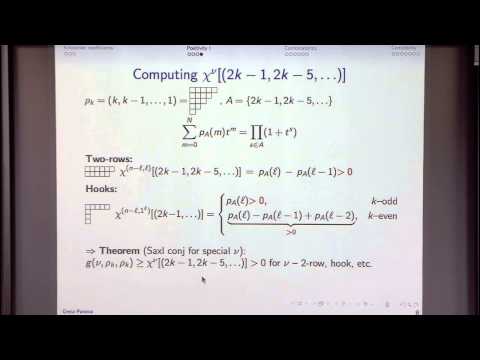
Defines Kronecker coefficients g(λ,μ,ν) as tensor-product multiplicities and states key complexity claims: positivity decision is conjectured polynomial but not even known to lie in NP, and exact computation is #P-hard (so in GapP). Main tools are symmetric‑function identities, a character lower bound comparing g to |χν|, reductions to counting three‑way contingency tables, and partition asymptotics; special cases become tractable (hooks, two rows, fixed length) and some stability/semigroup finite‑generation results give theoretical linear‑time tests but no practical generator list.
AI-written summary · about
chapters (17)
- 0:00Intro
- 2:17The combinatorial problem
- 5:20Kronecker coefficients and GCT
- 11:55Positivity problems
- 14:40Positivity results : Saxl conjecture
- 19:46Character lemma
- 27:01Symmetric function techniques 11
- 33:13Easy example MathOverflow question Jiarui Feil: Is there an easy way to see why
- 36:04Applications: partitions inside a rectangle m
- 39:59Kronecker and partitions inside a rectangle
- 42:45Further: effective bounds
- 44:18NP and #P from combinatorics
- 45:57Complexity of KRON and KP
- 50:16Proofs 1: the Reduction Lemma
- 52:22Proofs II: Explicit bounds on KRON complexity
- 53:51The theorem
- 57:48The analogous question for characters