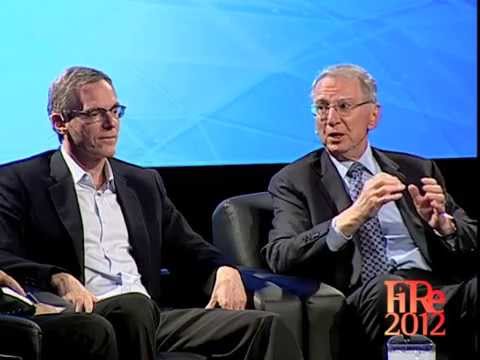
The Future of Wireless: A Centerpiece Conversation with Irwin Jacobs
summary
Claims CDMA solved spectral efficiency and funded R&D via an upfront licensing model that seeded chips and Snapdragon IP; trials use seven indoor small cells to cover a campus and engineers predict 1000x data demand, driving a plan for small cells cheaper than phones deployed per room with Ethernet/Wi‑Fi backhaul. Concrete numbers: 1.7 billion 3G users now, ~1.6 billion more in emerging markets by 2016; education pilots show smartphone classes moving pass rates from ~66% to 100%.
AI-written summary · about
chapters (28)
- 0:00Welcome and introduction
- 1:51Family and early Qualcomm stories
- 5:01Founding Qualcomm and CDMA vision
- 7:32CDMA vs TDMA battle and adoption
- 10:01Paul Jacobs becomes CEO
- 11:03Wireless internet and Snapdragon vision
- 13:28IP licensing and business model shift
- 17:20First commercial systems in Hong Kong and Korea
- 18:21High-speed data and energy-efficient chips
- 20:10Qualcomm’s five-year plan and computing future
- 22:14Thousand-fold data demand and small cells
- 23:37Femtocells and network deployment
- 25:39Internet of Things and health sensors
- 27:03Small cell radiation and health concerns
- 28:06Wi-Fi and cellular convergence
- 30:14U.S. broadband leadership with LTE
- 33:44Wireless and wireline synergy
- 35:07Global broadband in emerging markets
- 36:32Wireless Reach and social impact
- 38:39Smartphone vs feature phone transition
- 40:25Affordable smartphones for all
- 42:11Mobile education and digital divide
- 42:31Peer-to-peer and mesh networks
- 44:17Situational awareness and privacy
- 45:41Windows RT and trusted computing
- 47:02Security and nation-sponsored IP theft
- 48:28Wireless education research program
- 51:16Closing remarks and awards