Pilgrim's Progress to the Promised Land

summary
Migrating to Elixir/OTP surfaces concrete pitfalls and remedies: design for millions of lightweight processes with isolated state and asynchronous messages, use OTP supervisors (often expressible as OTP supervisors in one page) and plan error policies up front so the system attains five nines reliability, avoid macros unless a function cannot do the job, and use runtime introspection like observer and dbg tracing tools (plus Recon/Redbugger or Wombat OAM) and polyglot bridges (JInterface, Erjang, Purelang) to integrate heavy computation or legacy code.
AI-written summary · about
chapters (12)
- 0:00Intro
- 1:48Whats this all about
- 2:50Are you following the right prophets
- 4:17Whats it all about
- 8:30Where did we end up
- 10:35Are we good at everything
- 14:56Functional languages
- 16:03Concurrency
- 18:00Frameworks
- 19:58Fault Tolerance
- 25:39Macros
- 27:59Languages
related talks
 52mKeynote: Pilgrim's Progress to the Promised Land
 03h 19mWorkshop - All Aboard The Elixir Express!
 22mElixir is for DOING Things
 41mIdioms for building fault-tolerant applications with Elixir
 37mModern Abstractions and the Web, and avoiding Pitfalls because Life is short
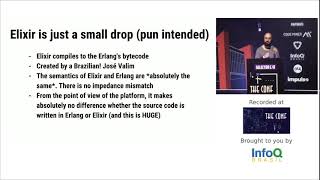 42mIt's about (run)time -- Elixir beyond the hype
 47mElixir for curing product development pains?
 01h 03mThinking Erlang in a connected world