On How Your Brain is Conspiring Against You Making Good Software

summary
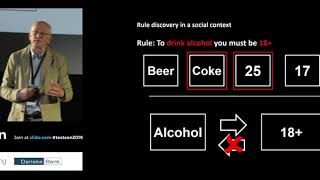
Covers specific cognitive experiments and practical fixes: categorical syllogisms show only 9% draw correct conclusions, the Wason card task gets 4% right abstractly but 73% with concrete beer/age examples, and students estimate thesis time as 34→56 days with only 30% on time. Uses Stroop, dichotic listening, insight puzzles, and IKEA/confirmation bias studies. Recommends concrete tactics: ask disconfirming questions, use past task data for estimates, take breaks, pair on bugs and recruit diverse teams to widen associative memory and surface missed solutions.
AI-written summary · about
chapters (19)
- 0:00Introduction to talk
- 1:28What is cognitive science
- 3:56Logic in programming
- 6:25Debugging and confirmation bias
- 9:10Mental sets and problem solving
- 10:58Creativity and associative memory
- 11:41IKEA effect in software
- 13:06Planning fallacy and sunk costs
- 15:13Selective attention and distractions
- 17:24Stroop task and mental effort
- 18:29Feelings and human interaction
- 19:10Dunning-Kruger effect
- 20:59Imposter syndrome
- 22:08Referral bonuses and homogeneity
- 22:49Fundamental attribution error
- 24:13Availability and representativeness heuristics
- 26:20Diversity in programming
- 27:46Evolution of cognitive biases
- 28:50Conclusion and Q&A
related talks
 30mOn How Your Brain is Conspiring Against You Making Good Software
 35mYour Brain is a Liar: Cognitive Pitfalls at Work & How to Fight Them
 07mSAG Expert Interview #02: How Cognitive Biases Impact Software Architecture
 52mYour Brain on Software Development
 21mDerailing irrationality
 39mHow Cognitive Biases Affect our Software Architectures
 43mReasoning Skills within Software Testing
 47mFantastic Biases & Where to Find Them in Software Development