Demystifying Deployments: Applications or Clusters, Active and Reactive Scaling - What is it about?

summary
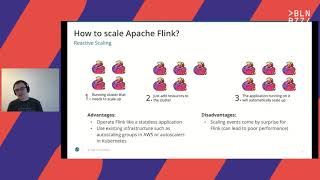
Explains concrete deployment choices for Apache Flink: application mode bundles job and cluster to avoid jar distribution, session clusters use a two-step submit requiring task managers with slots (default one slot each) and examples show a job with parallelism 2 needing two slots. Shows container and orchestration integrations—native Kubernetes, Docker, YARN—and demos reactive scheduler mode on Kubernetes that scales from one to three TaskManagers, auto-rescales using the latest checkpoint (restored checkpoint 9). Notes Mesos deprecation and YARN per-job legacy mode.
AI-written summary · about
chapters (10)
- 0:00Introduction
- 1:11Standalone Resource Provider
- 8:52Application Mode
- 12:30Docker
- 14:46Kubernetes
- 16:33Demo - The Reactive Mode on Kubernetes
- 20:50Native K8s Session
- 24:19Native K8s Application
- 24:56YARN
- 26:52The deployment decision matrix
related talks
 41mRunning Apache Flink everywhere
 20mAutoscaling Apache Flink Applications
 41mIntroducing Flink on Mesos
 43mDynamic Scaling - How Apache Flink adapts to changing workloads
 38mAutoscaling Flink at Netflix
 37mBuilding and operating large-scale streaming applications at King
 42mApache Flink deep-dive #bbuzz
 42mApache Flink meets Apache Mesos and DC/OS