Ziggurat: A Tiered File System for Non-Volatile Main Memories and Disks

summary
Ziggurat is a tiered file system built on NOVA that steers writes between NVMM, DRAM and SSD using two online predictors—the synchrony predictor (detects likely fsync/blocking writes) and the write-size predictor (detects large, stable writes)—and uses average-modification-time to find cold regions. Cold data moves via group migration that coalesces small NVMM writes into large sequential SSD writes; reverse migration enables mmap. Evaluation (NVMM emulation) shows up to 38.9x and 46.5x throughput over EXT4 and XFS on SSD; performance approaches NVMM-only as NVMM capacity grows.
AI-written summary · about
chapters (16)
- 0:00Intro
- 0:32Background
- 1:38Motivation
- 2:22Tiered Storage System
- 3:00Ziggurat Overview
- 4:07Outline
- 4:36Data Placement Policy
- 5:49Synchronicity Predictor
- 7:40Write Size Predictor
- 9:36Cold Data Identification
- 14:22File Operations
- 16:11Evaluation
- 18:01Filebench
- 19:02Rocksdb
- 21:08Conclusion
- 28:23Migration Mechanism
related talks
 15mTIPS: Making Volatile Index Structures Persistent with DRAM-NVMM Tiering
 46mZMS a New Lightweight Storage System
- 46mZMS a New Lightweight Storage System
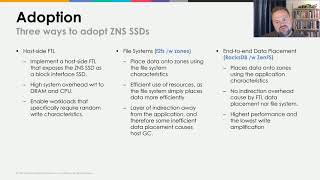 16mZNS: Avoiding the Block Interface Tax for Flash-based SSDs
 27mPreview: Storage
 19mA zone-aware cache system for distributed databases
 52mHow ZNS SSD's Are Changing the Landscape
 23mRubbleDB: CPU-Efficient Replication with NVMe-oF