New upper and lower bounds on approximate counting
summary
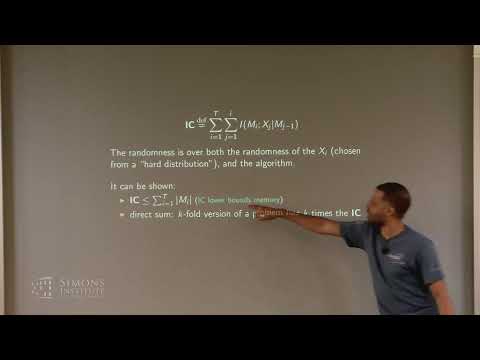
Proves tight upper and lower bounds for Morris-style approximate counters, replacing the old log 1/δ failure-term by a log-log 1/δ dependence and showing this is optimal. Key tools are geometric/Zi decomposition, MGF/subgamma concentration bounds, and an information-complexity direct-sum lower bound based on Braverman Garg Woodruff. Implements a practical variant with a one-line deterministic prefix fix that keeps space to the stated bound and matches theory in experiments.
AI-written summary · about
chapters (11)
- 0:00Welcome and introductions
- 2:10Workshop overview
- 5:02Introduction to approximate counting
- 6:53Motivation for Morris counting
- 11:07Basic randomized counters
- 14:10Optimizing memory and variance
- 17:02New algorithms and lower bounds
- 22:36Analysis of the improved algorithm
- 30:04Refining the Morris counter
- 34:48Proving lower bounds
- 39:49K-fold counting and conclusion