Bringing Compute to Embedded Hardware
summary
Argues that standard C++ can target GPUs and embedded accelerators without new language extensions by using SYCL buffers/accessors to declare data dependencies and fuse kernels, compiling device kernels to SPIR‑V device compilation and JITing per GPU at runtime. Shows a working toolchain: CPU fallback, hipSYCL/triSYCL implementations, and a Renesas R‑Car port running OpenCL+SYCL and TensorFlow-backed BLAS/convolution kernels. Demonstrates CPU vs on‑die GPU peak (~3x) and claims fused-ranges reduce unnecessary synchronization and copies, enabling real, portable offload on embedded boards.
AI-written summary · about
chapters (20)
- 0:00Introduction and background
- 1:29High-end embedded hardware trends
- 5:01GPGPU limitations and history
- 9:03GPU architecture and OpenGL
- 11:32How GPUs differ from CPUs
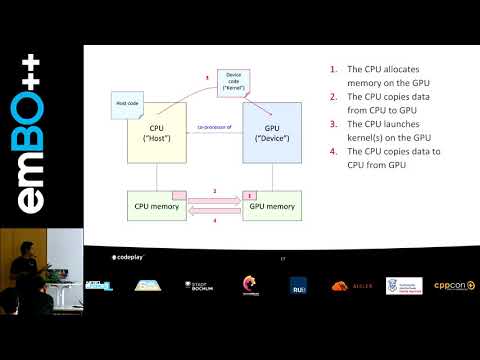
- 13:22Memory hierarchy and data transfer
- 16:37GPGPU programming models
- 19:04Introducing SYCL for GPUs
- 22:41SYCL code example and benefits
- 26:38Compiling SYCL for CPU and GPU
- 28:16Device code compilation details
- 31:08Intermediate representation and SPIR-V
- 32:55SYCL and JIT compilation
- 33:58Executors and C++ standardization
- 35:06Parallel STL with SYCL
- 36:31Composing kernels with ranges
- 38:18SYCL in libraries like TensorFlow
- 39:45SYCL ecosystem and implementations
- 42:36Libraries and tools in SYCL
- 43:40Learning resources and documentation