ClickHouse: what is behind the fastest columnar database

summary
Columnar storage with per-column files, targeted compression codecs and vectorized execution lets ClickHouse handle billions of rows and tens of GB/s for OLAP workloads; the default MergeTree engine creates many parts that merge over time (batch inserts ~10k rows recommended) and uses a sparse primary index that jumps by roughly 8k rows so point-lookups are slow. Integrations include Kafka and external dictionaries, joins are available but costly, deletes are lightweight markers applied during merges, and vector-search via embeddings is practical inside the database.
AI-written summary · about
chapters (16)
- 0:00ClickHouse introduction
- 1:30Why ClickHouse for OLAP
- 6:29OLTP vs OLAP differences
- 10:01ClickHouse architecture
- 13:56Indexing and data skipping
- 18:38Vectorized execution
- 19:24Demo: Restaurant menus
- 24:25MergeTree engine
- 26:08Why denormalization boosts ClickHouse performance
- 28:17Joins and dictionaries
- 31:32Trend analysis
- 33:01Vector search with embeddings
- 35:09ClickHouse with Kafka
- 38:00Common pitfalls and when not to use ClickHouse
- 40:27Resources and getting started
- 41:54Q&A: JDBC timeouts
related talks
 42mClickHouse: what is behind the fastest columnar database
 34mClickHouse® - What is Behind the Fastest Columnar Database?
 28mColumnstore Revolution
 26mColumnar Storage: Redefining Data Management for the Modern Era
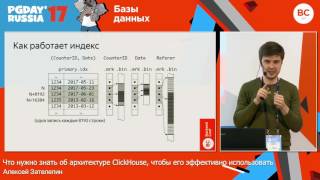 51mWhat You Need to Know About ClickHouse Architecture
 40mData warehouse or conventional database: Which is right for you?
 26mHandling Large Volumes of Immutable Structured Data With ClickHouse
 59mEffective Use of ClickHouse