The Fundamentals of Strategy
summary
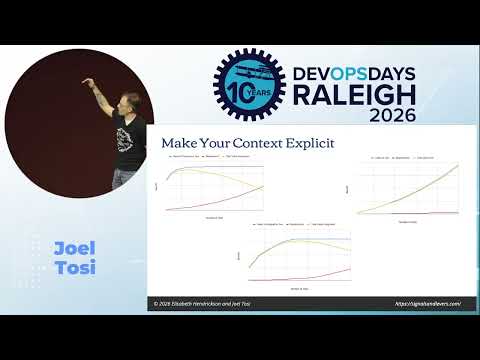
Argues that strategy starts with a clear problem not a prescribed solution and uses concrete tools: overlaying unit/regression/integration test ROI curves to pick tradeoffs, using a Shewhart control chart to ignore natural variability, applying causal modeling to expose root causes (batch size, coupling, release cadence), and treating AI as an amplifier of existing problems. Recommends picking decisions that preserve or expand options (a practical U-curve tradeoff: cost of being wrong vs number of parallel experiments).
AI-written summary · about
chapters (13)
- 0:00Introduction and welcome
- 0:44What is strategy?
- 1:48Avoid starting with solutions
- 3:32Understanding context matters
- 5:56Strategy requires options
- 7:19Analyzing options with data
- 11:32Reacting to variability vs strategy
- 13:38Quality problems and ripple effects
- 16:04Strategic thinking tools
- 18:31Causal modeling and variability
- 20:15Future-proof decisions
- 20:36Red Hat story and closing remarks
- 21:59Q&A on strategy