AI Agents for Java Devs From Demo to Deployment
summary
A working end-to-end invoice pipeline parses PDFs with an external GPU parser, validates totals and line items, and flags anomalies automatically. It uses a Python GPU microservice calling the Neotron parser for OCR and bounding boxes, an orchestrator backed by GPT-4 in Microsoft Foundry, and containerized deployment on Azure Container Apps with OpenTelemetry/Jaeger tracing. Demo detects a $20 subtotal mismatch and an inflated premium-support line, scales GPUs to zero when idle, and supports Java clients via LangChain4j/Spring AI.
AI-written summary · about
chapters (13)
- 0:00Introduction to AI agents
- 1:55Why agents matter for Java devs
- 3:20Agent architecture and patterns
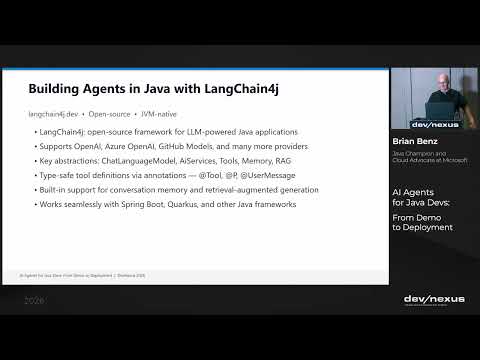
- 10:16Building agents in Java
- 14:31Real-world use cases
- 18:06Demo walkthrough
- 21:21Running the invoice processing demo
- 33:12Choosing and deploying models
- 39:56Production patterns and observability
- 44:16Deployment scripts and automation
- 47:06Evaluating and testing agents
- 51:02Pitfalls to avoid
- 52:04Key takeaways and resources
related talks
 29mAPI Integration augmented by GenAI
 42mAI Agents in Action: Transforming Enterprise Processes
- 42mAI Agents in Action: Transforming Enterprise Processes
 49mPractical AI in Java
 45mThe Overwhelmed Spring Developer's Guide To AI
 34mThe Hard Truth About AI Agents in Production
 46mGenerative AI and Java
 53mUnleash the Power of AI Agents with Java Building Intelligent Application