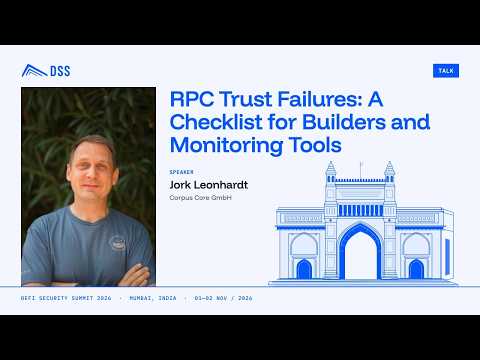
RPC Trust Failures: A Checklist for Builders and Monitoring Tools
summary
A postmortem shows a verifier accepted a forged burn proof because its RPC nodes were poisoned and honest providers were DDoSed, letting a single signed message release 116,500 RS ETH (~$292M). Audited contracts behaved correctly; the failure is the unverified data pipe. Builders get a tight checklist — four questions: independent sources, verification, disagreement handling, provider concentration — and monitoring gaps (response integrity, visibility). Fixes use Merkle-proof light-client verification, e.g. Colibri.
AI-written summary · about
chapters (13)
- 0:00Introduction and context
- 1:44RPC trust failures explained
- 3:09Four RPC failure modes
- 5:58Builder checklist introduction
- 6:20Independent sources requirement
- 7:25Response verification necessity
- 8:06Handling source disagreement
- 8:47Concentration and legal risks
- 9:51Monitoring tool gaps
- 10:35Visibility in RPC dependencies
- 12:00Redundancy vs verification
- 12:41Three key takeaways
- 13:24Q&A and resources