Control of Synaptic Plasticity in Deep Cortical Networks
summary
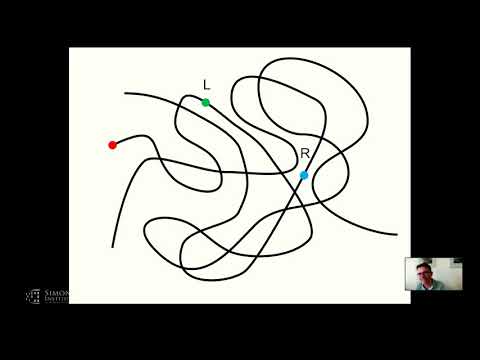
Claim: feedback signals label only the neurons that will change, turning late apical dendrite calcium events into an eligibility trace that, combined with a neuromodulatory reward signal, produces synaptic change. Evidence: simulations of recurrent networks learn curve tracing, motion-category and delayed-saccade tasks in hundreds–thousands of trials using a biologically plausible 3–4 factor rule. Biology: whisker stimulation produces NMDA-dependent apical plateau potentials and ~20% LTP in layer 2/3 that disappears with POM (higher-order thalamus) inactivation, consistent with feedback-gated plasticity.
AI-written summary · about
chapters (15)
- 0:00Start
- 2:06Perceptual Organization
- 4:31Primate Visual System
- 5:24Selective Attention
- 11:26Receptive Fields
- 14:53The Reinforcement Learning Regime
- 17:39The Credit Assignment
- 25:15Cue Learning
- 25:56Q Learning
- 28:07Input Layer
- 28:48Completely Random Connectivity
- 33:14Recurrent Connections
- 33:56Neurobiology
- 34:56Repetitive Whisker Stimulation
- 41:30Conclusions
related talks
 01h 13mComputation in Networks of Neurons in the Brain II
 27mWhat can artificial neural networks learn from biological neuromodulatory systems?
 31mNeuromorphic computing in spiking neuron-astrocyte networks
 12mComputation with sequences of neuronal assemblies
 32mHow Neuroscience Makes AI Intelligent
 30mCracking the code: neuronal networks in the brain
 43mCoin-Flipping in the Brain: Probabilistic Computation and Learning in the Assembly Model
 11mTo Boldly Grow... Live Brain Cells that Learn to Play Pong