Conversational Computing: How Okasaki proved McCarthy right again
summary
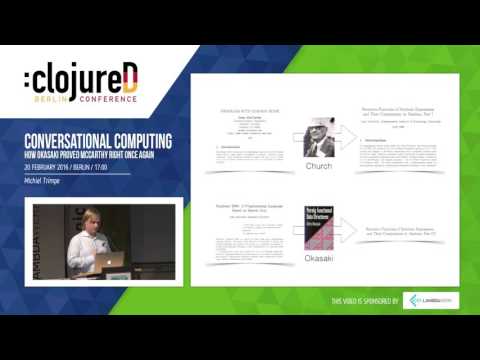
Claim: combining McCarthy's Elephant 2000 with Okasaki-style persistent data structures yields conversational computing — systems built from sequences of immutable statements that reference history. Evidence: Unison (2013) and Oxlang implement a fully pure lambda calculus with content-addressable, memoized code and a content-addressable Merkle AST enabling remote function application, semantic editors and fast, cache-never-invalidated offline apps. Deliverables: historical-code-aware compilation, deploy-as-experiment rollouts, user-playback debugging, signed provenance and end-to-end encryption that make provenance, authenticity and NSA-resistant privacy practical.
AI-written summary · about
chapters (20)
- 0:00Introduction
- 0:19Puzzle Time
- 0:55The Advicetaker
- 2:12McCarthys Conundrum
- 2:51My Theory
- 4:06The List Paper
- 4:17John Searle
- 5:58McCarthys vision
- 7:33McCarthys lost edge
- 9:59Elephant 2000
- 11:26McCarthys Puzzle Tick
- 13:05Recursive Functions
- 13:33Unison
- 15:21Eve
- 16:07Historical Code Awareness
- 22:03Nonfunctionals
- 24:39Transparent actors
- 26:08Provenance tracking
- 27:28Conversational authenticity
- 28:14Conversational privacy
related talks
 49mIntelligent Interfaces and operating systems
 33mParallel Processors: Past & Future Connections Between LLMs and OS Kernels.
 49mCoding Tomorrow
 44mSome History of Functional Programming Languages
 42mKEYNOTE: Liveness, Literacy, Local First, Lambdas and Llamas
 46mClaude AI is not intelligent | Stochastic Architecture
 49mPushing LLMs over the Edge: Exploring the Limits of the Possible
 25mVerifying LLM powered Code Transformations with Equivalence Checking