Yann Dupont @ Ceph Day Paris
summary
University deployment runs Ceph across three main sites with 15 servers (12 disks each) and ~514 TB raw (≈140 TB usable) split into five clusters; production since 2012 after earlier OSD crashes, XFS corruption and rebuild storms leads to dedicated hardware, LXC virtualization and bonding two 10 Gb networks. They use one LXC per disk early but move to fewer containers, enforce data-center-aware CRUSH rules, use SSD journals (prefer SLC for journals), tune PGs and plan erasure coding k=4 m=1. It works in production.
AI-written summary · about
chapters (21)
- 0:00PRACTICAL EXPERIENCES RUNNING CEPH IN
- 1:16NETWORK TOPOLOGY IN NANTES
- 2:34NETWORK TOPOLOGY CONTINUED
- 3:03STATE, START OF 2012 Distributed services 1 Router, 2 FW, 2 LVS directors per location Bunch of machines for services
- 3:55IN CASE OF SINISTER
- 4:38FAULT TOLERANT, DISTRIBUTED STORAGE
- 5:54BUGS & DISAPPOINTMENTS
- 7:56DON'T PUT ALL YOUR EGGS IN ONE BASKET
- 10:02CURRENT (3RD) DEPLOYMENT (2014)
- 11:16NETWORK HIGH AVAILABILITY
- 13:02HARDWARE
- 13:40CEPH CLUSTERS AND USAGE
- 15:40POOLS PER CLUSTER
- 19:17FAULT TOLERANCE : TESTED!
- 20:06NETWORK CONNECTIONS, SCALABILITY
- 21:23LATENCY & LOCALITY Client is on LMB.
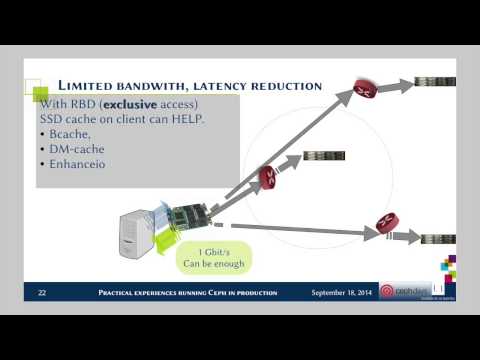
- 23:23LIMITED BANDWITH, LATENCY REDUCTION
- 25:43TIERING + ERASURE CODING
- 27:52LESSONS LEARNED (3)
- 36:13PERFORMANCES (WAS ON DUMPLING) Relative speed
- 37:08CONCLUSIONS